Happy Pansexual Pride Day!
Today, 8 December, is Pansexual Pride Day, one of two days in the year that explicitly recognizes and celebrates pansexual people.
What does “pansexuality” mean?
Etymologically, pansexual comes from the ancient Greek prefix pan– (“every,” “all”) with the late Latin adjective sexualis (“sexual,” “relating to sex;” from the Latin noun sexus, “sex,” “gender”). Some linguistic purists object to mixing Greek and Latin roots, but hybrid words are ubiquitous and entirely unremarkable: television, biodiversity, neuroscience, etc. It’s absolutely fine.
Pansexuality is sexual attraction to a person regardless of their gender identity. A pansexual person is attracted to someone for who they are, not (solely) what their body looks like. Someone who is pan (a short form of “pansexual,” similar to the way “bi” is short for “bisexual”) may experience sexual, romantic, and/or emotional attraction to people of any (or no) gender.
Panromaticism is the romantic parallel: romantic attraction to people regardless of their gender. A panromantic person may also be pansexual, or they could be queer, gay, lesbian, straight, or asexual. Romantic and sexual attraction do not always correspond. (Of course, a person may be asexual or aromantic and identify with pan terms, but the remainder of this piece focuses on pansexuality specifically.)
A pan person may be of any gender modality or no gender at all: cis, trans, intersex, genderqueer, genderfluid, agender, or anywhere else on or outside the vast spectrum of gender diversity. A person’s sexuality is not dictated by their gender, nor is it constrained by the presence or lack of gender or genders of the people they’re attracted to. Instead, it reflects a pattern of attraction shaped by the person’s desires rather than by externally imposed assumptions about who they “should” be drawn to.
Pansexual Pride Day is an opportunity to celebrate pansexual people, and encourage education and greater recognition of pansexuality.
A brief history of pansexuality
While pansexuality has been observed in various ways throughout history, the term itself is first attested to in 1914 and later taken up by Sigmund Freud, where it bore a slightly different meaning that focused on his theories of universal libido, rather than a discrete sexual orientation or identity.
The use of pansexual as a sexual orientation or identity gained new attention in the 1960s and was suggested as a replacement for bisexual in the 1970s. In the 1990s, as genderqueer and other nonbinary identities became more widely discussed, pansexuality became increasingly associated with sexual fluidity and attraction in ways that explicitly transcend binary gender categories.
Earlier definitions of bisexuality framed it as sexual attraction to people of the “same” or “opposite” genders, a binary that often excluded genderqueer, nonbinary, and agender people. Over time, the definition became more inclusive, and today bisexuality is more commonly understood as attraction to more than one gender and also includes attraction to agender people. Periodically, debates reemerge about whether bisexuality includes trans people (binary or nonbinary or agender), but in contemporary 2SLGBTQIA+ discourse, bisexuality is broadly recognized as trans- and intersex-inclusive.
M-spec (multisexual spectrum) identities are always expanding as people find new, more precise language to describe their experiences. Pansexuality is generally understood to fall under the broader m-spec umbrella, which also includes identities like bisexual, omnisexual, and polysexual.
The Pansexual Pride flag was designed in 2010 (more on that below), but the origins of Pansexual Pride Day itself are less clear. The earliest articles explicitly celebrating it appear around 2018, though Google Trends data shows searches for the term beginning around 2015; however, that may simply reflect people searching to see whether such a date existed.
For those interested in a more detailed historical overview, the following timeline offers an excellent place to start:
- A Timeline of Pansexual History, History of Pansexuality (Google Doc)
How did the Pansexual Pride flag emerge?
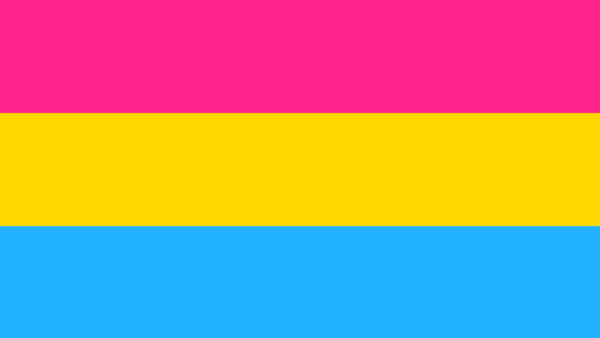
The Pansexual Flag was designed in 2010 by Jasper Varney, an English queer nonbinary person. They first shared the design on Tumblr after creating it “on a whim” because they wanted something visually appealing for their blog. They didn’t expect it to take off and when they first saw the flag in person at a local Pride parade, they later said it brought them to tears.
The colours represent the gender spectrum:
- pink: attraction to women
- yellow: attraction to nonbinary people and others
- cyan: attraction to men.
In a 2018 interview, Varney noted that when they designed the flag, the bisexual label was actively being contested online. Some spaces they participated in used definitions that excluded trans people from the scope of bisexuality or made unnecessary and harmful distinctions between cis and trans people. As a result, it felt like “a term that didn’t work for [them] personally anymore.”
Although several alternate versions of the pan flag have been proposed, the magenta, yellow, and cyan design remains the most widely used by far.
As a goth, I find it very bright, so I rarely use it, but I appreciate its existence and am genuinely glad to see its visibility continue to grow.
The pansexual symbol
Before the emergence of the flag, a distinct pansexual symbol circulated within queer and trans spaces, though its exact origins are unclear. It draws from the Mars (♂) and Venus (♀) symbols that often used to represent men and women and adapted in various ways as symbols for gays (♂♂) and lesbians (♀♀).
The pansexual symbol uses a stylized P that incorporates:
- a P for pansexual
- an arrow reminiscent of the Mars symbol
- a plus sign reminiscent of the Venus symbol
The design was intended to suggest attraction that extends beyond a single gender, even though it remains limited by its reliance solely on Mars- and Venus-inspired elements rather than incorporating symbols for other genders.
Its usage has declined since the pan flag’s rise in prominence, and sourcing a more detailed history has proven challenging. When it does appear today, it is often recoloured in the magenta, yellow, and cyan of the Pan Pride flag.
Dispelling myths
Panphobia and biphobia persist in many forms, unfortunately. Pansexual people are not “confused” about who they are attracted to, nor are they “serial cheaters,” going from one person to the next because they’re indiscriminately attracted to everyone, or any of the other myriad stereotypes projected onto both the pan and bi communities.
A pansexual person may be monogamous, polyamorous, or asexual; they may have many partners or none; they may be quiet introverts, flamboyant extroverts, or anything in between. Pansexuality describes who one may be attracted to — not how one behaves in relationships.
Pansexuality and bisexuality are neither adversarial nor mutually exclusive, and both fall under the m-spec umbrella. Many people feel more comfortable with the label bi because it’s become more widely familiar, particularly among cishets; others prefer pan because it explicitly signals gender-inclusive attraction. Some people use both terms interchangeably, depending on who they are talking to. Both labels are simply different ways of describing multisexual attraction.
Pansexual people are not attracted to everyone all the time. Attraction to a person regardless of gender does not mean attraction to every single person, any more than being attracted to men means being attracted to all men. Each pan person has their own preferences, types, tastes, and boundaries; it’s a matter of range of possible attraction, not frequency.
Pansexuality is not new, it’s not a fad, and it’s not a “cry for attention.” This kind of dismissive framing has been directed at virtually every queer or trans person at some point and it functions to invalidate lived experiences and pressure people to silence or hide parts of themselves out of fear of backlash. Recognizing pansexuality as a legitimate, longstanding orientation helps counter stigma and affirms the reality of the people who identify with it.
What being pansexual means to me
I use the term pansexual because it’s the word that best reflects how I experience sexual attraction. My interest in someone isn’t determined by their gender; it’s shaped by a constellation of qualities: some obvious, some ineffable, and some that others might arbitrarily code as gendered, even when I do not experience them that way. Pansexuality is simply the best linguistic fit for the shape of my attractions.
For me, being pan is fundamentally about openness and freedom from having to parse or prioritize gender before recognizing a moment of interest, or worrying about how someone identifies, or what combination of body parts they have. It means I can register attraction — whether to my partner, a celebrity, a fictional character, someone I meet at an event, or see in a crowd, — without needing to slot it into a category or justify it.
And attraction, of course, doesn’t imply intent or obligation. I’ve been in a monogamous relationship for more than 26 years and, like anyone else, my attractions can range from long-standing crushes to brief flickers of curiosity. They’re part of my internal landscape, not demands for action. Being pan simply describes how those sparks arise — not what I do with them.

Conclusion
Honouring Pansexual Pride Day means recognizing and celebrating pansexual people, and promoting a more inclusive understanding of attraction and countering misunderstanding or hostility.
Celebrating pan people today is also a commitment to making space for those whose identities continue to expand and enrich our 2SLGBTQIA+ communities.
What you can do:
- learn more about pansexuality and educate others
- use accurate and respectful language
- listen when pansexual people share their experiences
- uplift pan voices
- show consistent support for 2SLGBTQIA+ rights and stand up against discrimination
- promote acceptance and understanding in your circles
Key dates
- 24 May is Pansexual and Panromantic Awareness and Visibility Day
- 8 December is Pansexual Pride Day
Further Reading
- “Pansexual Pride Day,” Canadian Pride Historical Society
- “How You Can Celebrate Pansexual Pride Day,” gayety
- “Pansexual Pride Day: Everything You Need To Know,” The Rainbow Stories
- “Pansexual and Panromantic Visibility Day,” The Rainbow Stories
- A Timeline of Pansexual History, History of Pansexuality (Google Doc)
- “Frequently asked pansexual related questions,” History of Pansexuality (Google Doc)
- “Interview: Creator of the Pan Flag,” Majestic Mess Designs
- “Pansexuality: What it is, what it isn’t,” The Trevor Project”
- “Omnisexual, gynosexual, demisexual: What’s behind the surge in sexual identities?,” Canadian Association for the Club of Rome
- “National Pansexual Pride Day,” Seattle Pride