Review: Thirst, by Marina Yuszczuk
Thirst, by Marina Yuszczuk, translated from the Spanish by Heather Cleary (Dutton, 2024)
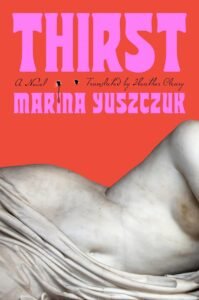
You ever find yourself reading a novel about a bisexual vampire on Hallowe’en and then somehow it’s 2 am, and you’ve finished it, but you still can’t stop thinking about it? Yeah.
This isn’t a formal review but more of a reflective essay — and there will be spoilers. So, if that’s a concern, this is probably a good point to stop reading.
I buy books faster than I can read them, and this one’s been sitting on my TBR pile probably since it came out in 2024 — certainly long enough that the back cover is now sun-faded. I must have once known Thirst was split into two parts with two protagonists, but I’d forgotten by the time I finally started reading it.
The switch between narratives felt a little jarring at first, but it’s what kept me reading into the early hours of the morning. Ultimately, the dual structure worked well, as the two perspectives complemented and echoed one another, deepening the story’s emotional resonance.
The first half follows an unnamed vampire arriving on the shores of nineteenth-century Buenos Aires. We glimpse her backstory in fragments: sold by her mother when she was only a child to the vampire who would become her master; the brutal destruction of her vampire sister-wives and her narrow escape; centuries spent wandering Europe, learning to survive on her own until another disaster drives her across the ocean.
She arrives in Buenos Aires amidst a plague, and the deaths she causes go largely unnoticed as carts regularly trundle through the city collecting the dead. She takes lovers, hunts at turns quietly or theatrically. Sex and violence are recurring, often intertwined themes. Her mother’s betrayal remains a sore spot, leaving her angry, hollow, and profoundly alone.
Her desires are immediate, all-consuming, and at the forefront of everything she experiences, but the particulars are fuzzy. She has no name, no nation; time and place are only loosely sketched. Names, for her, belong to others (lovers, a groundskeeper, children), but a name is not something she claims for herself.
Our protagonist learns to adapt and hide among the humans, but her attempts at discretion are self-delusion. She doesn’t understand or care what drives them. To her, humans are diversions, amusements, irritants, food — but scarcely sentient. Her only concerns are for her own survival and the brief, transgressive thrill of feeding from someone attractive. She’s truly a monstrous creature, and it’s gorgeous to behold.
The vampire tropes are sumptuous: sensual blood-drinking, ritual murder, disturbing sex scenes, velvet-lined crypts, luxurious coffins, the absence of a reflection and its implications for her general hygiene. It’s rich, dark, atmospheric, and dripping with Gothic decadence. The jacket copy compares Thirst to Frankenstein, but it feels closer to old horror cinema: Dracula and his brides, crypts of velvet and stone, beautiful yet filthy. When her crimes grow too visible, she retreats to a cemetery and befriends a groundskeeper in a rare moment of connection and restraint. As she comes to rely on him and moves towards building a genuine connection, she chooses to entomb herself and seal away her endless hunger.
The novel’s second half follows a young, divorced mother in present-day Buenos Aires who tends to her dying mother and energetic child, all while trying to hold the rest of her life together. We get a glimpse of her and her son in the prologue, but it’s not until the second half of that her story truly emerges. Where the vampire’s life is largely untethered from time, the modern woman’s is tightly bound to it. Her days are marked by visits with her mother, childcare, errands, and the quiet suffocation of obligation.
Her name, Alma, appears only once, and she doesn’t seem to think of herself that way, so I won’t either. It feels truer to how Yuszczuk’s protagonists reveal themselves: one so self-centred that claiming a name would be meaningless and the other so absobred in caring for others that her own identity nearly disappears.
In contrast to the vampire’s hazy centuries, these scenes are dated and successive: a chronology that builds towards an inevitable breaking point. She is responsible to and for others, and their needs always come before her own. Her fridge is empty, her body and mind exhausted; she cannot recognize the weight of the grief she carries until she is forced to take a leave of absence from work.
The novel’s two halves run parallel: the vampire’s narcissistic alienation mirrors the human woman’s self-erasure. One consumes to fill her hunger; the other is consumed by her obligation. Both are shaped by need, by desires that can never be fulfilled.
The modern protagonist inherits a legacy that brings her closer to the vampire, and their stories finally intersect. When life feels hopeless, when grief is so overwhelming that it becomes invisible, the sudden emergence of something immortal and powerful feels less like a threat and more like a release. It’s no wonder she’s drawn to it.
Already standing at the edge of desperation, she steps closer, chasing dead secrets long buried. Of course she releases an ancient evil. Of course she’s attracted to it. After all, death is another kind of surrender — a loosening of bonds and obligations. Her mother has been dying for years; she’s watched the slow decay of body and mind. In letting go of her familial obligations, she binds herself instead to an ancient and insatiable hunger. Even so, how could she not feel a kind of relief in the vampire’s easy intimacy with death?
I know something of that living grief. My mother died recently after years of illness. Hers was kidney failure from complications with diabetes; the protagonist’s mother’s disease is unnamed but it’s presented as degenerative and terminal. For me, the grief was made more difficult because I was not able to be with my mother or care for her in her last years.
Am I reading more into this than Yuszczuk intended? Maybe. But that’s what good literature does: it unsettles us and teaches us to think in new ways. It shows us things we’ve tried to hide and exhumes what we thought we’d laid to rest.
Marina Yuszczuk is an Argentinian novelist and poet, and the author of thirteen books. Thirst (La sed) is her second novel and first book to appear in English translation. Given the strength of this novel and its favourable reception, I hope we’ll see more translations from her back catalogue as well as future works.
Purchase from your local indepdent bookstore, or:
Note: This review contains affiliate links, which help me survive under capitalism, cost you nothing, and did not influence this review.